01
1. Listen
Is the damage new or has it been there for a while? When does it get worse, after rain, at night, when the air conditioning runs? The residents know more than any instrument, so every inspection starts with their account.
02
2. Locate
Where are the symptoms, and just as important, where are they not? A stain that stops at a certain line, a smell in one room only, a crack that follows a joint. The pattern already narrows the search.
03
3. Narrow down
Twenty years of building practice turn symptoms into a short list of likely causes. Often the investigation starts with the air conditioning, with possible leaks or with general defects in workmanship.
04
4. Exclude
Measurement rules out what can be ruled out. What remains is not necessarily a single cause: several causes can act together and be jointly responsible for damage or a defect. Some matters cannot be fully clarified, for example when opening up a component, a destructive investigation, is not approved. The report states what was measured, why other causes were excluded and what remains open.
05
Air in, air out
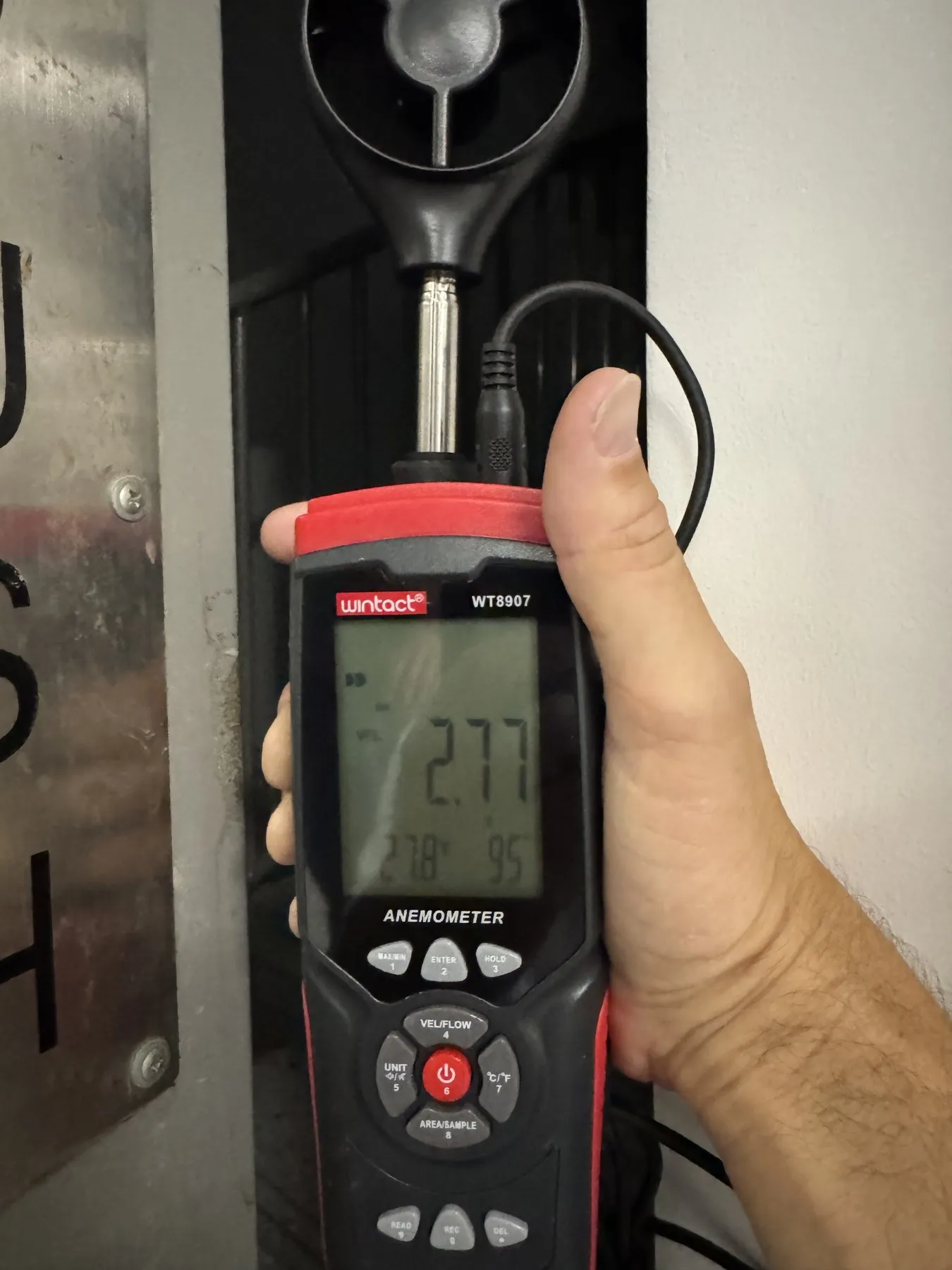
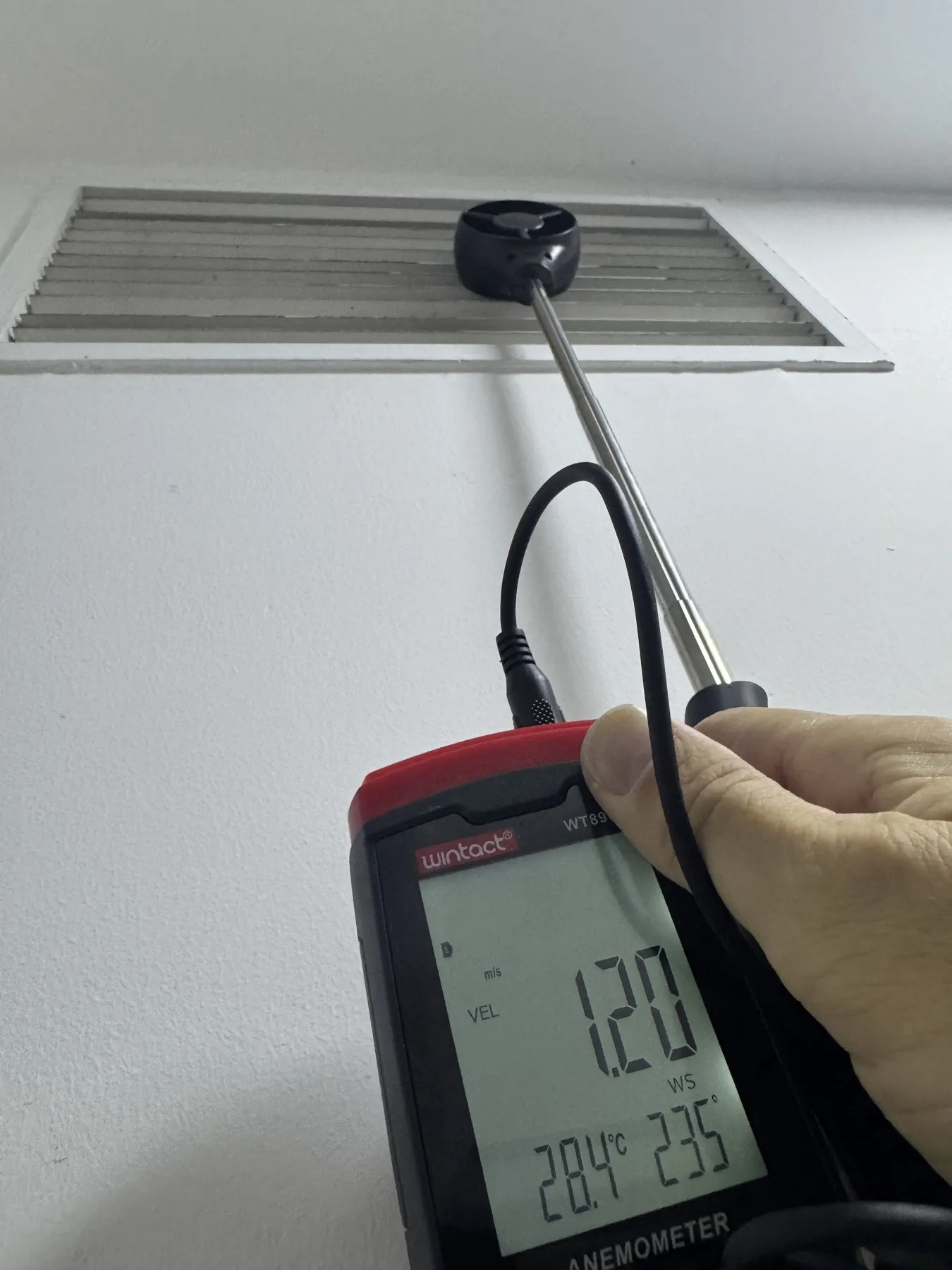
With air conditioning the first question is whether enough air comes in. The second is just as important: does it also go out again? If supply and return air are out of balance, the humid air stays in the room, and the system circulates instead of dehumidifying. That is why the airflow is measured at both grilles, supply and return.
A real case: an apartment whose air conditioning ran only in fan mode. Almost 80 % relative humidity in every room, mould on ceilings and furniture, the ceiling coming down. The cause was not the building but the setting.
06
Where defects hide
Behind the access panels run the pipes for air conditioning, water and drainage. That is where damage shows first, long before it reaches a wall. A leaking pool above, water dripping from floor to floor: none of this is visible at a viewing, and a lot of it has been covered up, often simply painted over by the decorator.
- Poorly routed pipes and ducts
- Substandard or damaged material
- Broken, scratched or hollow tiles
- Blocked drains and falls that run the wrong way
- Stains and cracks painted over before the viewing
07
Cracks: where do they come from?
Cracks are a standard topic in Dubai. The key questions: are they the result of design flaws or poor workmanship? Are they structurally relevant? And is the building still watertight?
The crack width gauge lies flat on the crack, with the crack running across the scale. The reading is dated and photographed, so a second measurement shows whether the crack is still moving.
08
Thermal imaging: explanation, not proof
A thermal image shows temperature differences, not moisture. It is very good at showing where to look and at explaining a finding to you. Whether a cold area is actually wet is decided by the moisture probe. That is why thermography is one of several possible methods, used where it adds real insight, for example for thermal anomalies at electrical connections and circuits, for tracing pipes or for possible leaks at building components. Thermal images often look impressive in a report, but they are not necessary or useful in every investigation, and never the only basis of a finding. Whether they are used depends on the task and the conditions on site.
09
The instruments
We use high-quality measuring equipment, some of it from Germany. What matters is not only where the instruments come from or how good they are, but above all that they are used correctly. Even high-quality instruments give unreliable results if they are applied wrongly or not maintained and calibrated as required, and that leads to unusable readings and wrong conclusions. A moisture probe held at a slant gives a worthless reading.
Which methods are used depends on the instruction, the specific question and what is technically necessary. The aim is always that the measuring technology is used in a targeted, professional way and delivers real insight.
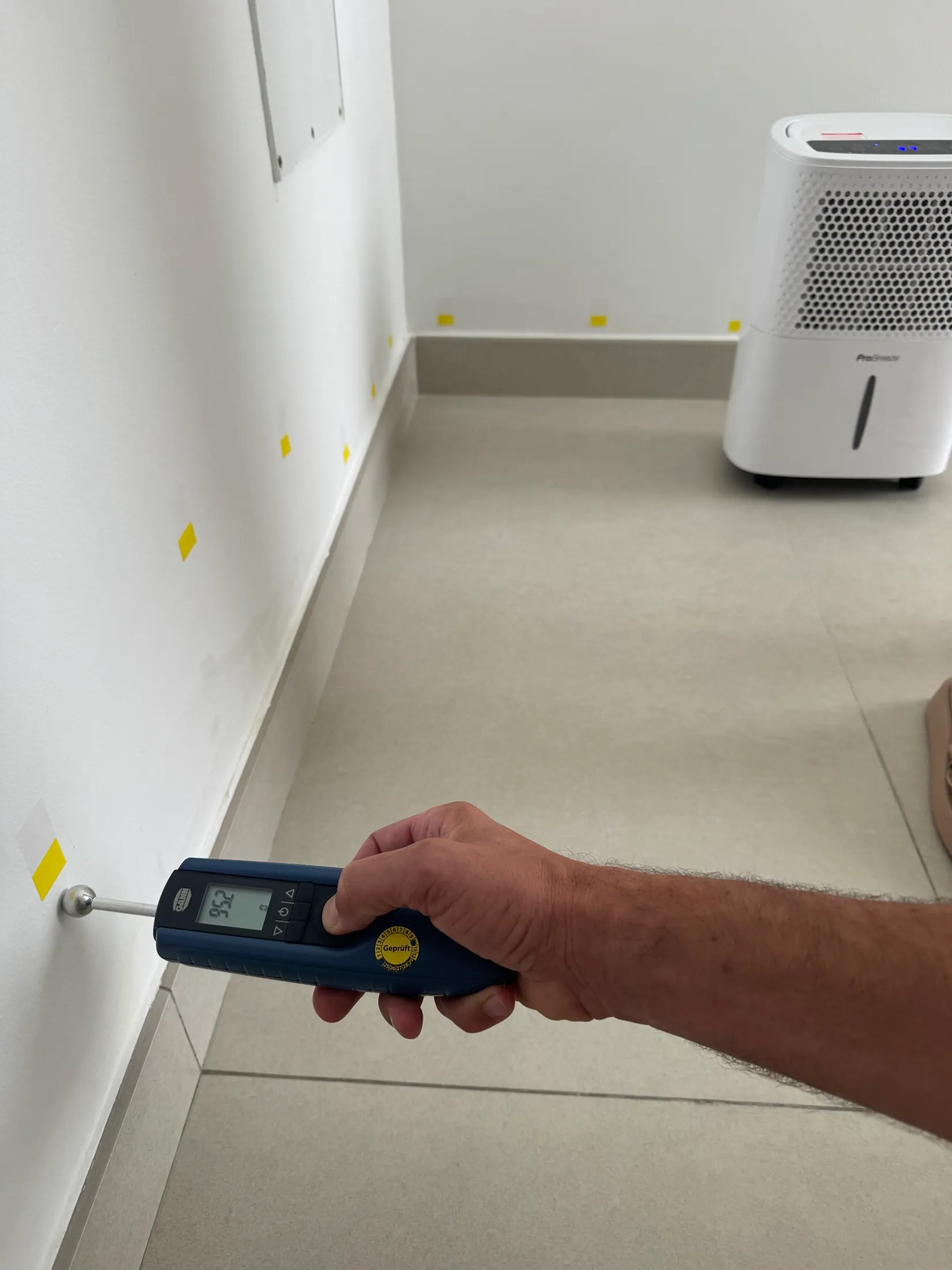
- Moisture measurement for different materials, probe at right angles to the surface
- Endoscope camera to look behind access panels and into cavities without opening them
- Anemometer for supply and return airflow of the air conditioning
- Smoke test that makes airflow and leaks at windows, grilles and valves visible
- UV lamp at 365 nm to show residues, moisture traces and what was painted over
- Thermal imaging where it adds insight: electrical connections and circuits, tracing pipes, possible leaks at building components
- Crack width gauge and feeler gauge to measure and monitor cracks
- Tapping rod for hollow tiles and render, water pressure test at the taps
- Air and surface samples taken on site, analysis by an external accredited laboratory
10
What the report separates
Observation, assessment and recommendation are kept strictly apart. You can see what was found, how it is judged and what should be done, and you can check every step.
11
Damage pattern, point of entry, cause
The place where damage becomes visible is often not the place where it starts. Moisture travels within building layers, along pipes and installations or through junctions, and appears somewhere else entirely. Whoever treats only the stain on the ceiling risks leaving the cause in place.
That is why I keep three things apart in every investigation: the damage pattern you can see, the point where water or moisture enters, and the actual cause behind it. Only when all three fit together is a finding sound. If they do not fit, the search continues, or the report says clearly what remains open.
12
What happens after rain
In Dubai, viewings and handovers almost always take place in dry weather. Buyers therefore rarely see how a villa behaves in intense rain. After the heavy rain at the end of March 2026, my inspections showed again and again that a property which makes an excellent impression in the sun can reveal significant weaknesses under load.
The typical weak points are structural transitions: between roof and parapet, at door thresholds, wherever different materials meet. Then drainage: water collecting against external walls, blocked or overloaded drains, standing water on terraces, falls that lead towards the building instead of away from it. Not every short pool of water is a defect. What matters are cause, duration, extent and the structural conditions. It becomes a problem when water stands at building junctions repeatedly or reaches areas that are not protected for it.
A freshly painted ceiling looks unremarkable. It does not tell you whether the cause of an earlier leak was removed. So I ask for the history: earlier moisture ingress, documented causes, maintenance records, and whether after earlier damage only the surface was renewed. An inspection cannot guarantee that every concealed defect, or a leak that only appears in certain weather, is detected. That limit belongs in any serious assessment, and I state it.
13
Mould at 40 degrees outside
Mould is one of the most important topics in Dubai, and it seems contradictory at first: forty degrees outside, moisture damage inside. The explanation is physics. When the actual temperature of a surface falls below the dew point of the air directly next to it, water can condense there. The outdoor temperature does not answer that question, and neither does the temperature set on the AC remote. What counts is the surface temperature and the moisture conditions at that surface.
A single reading in the middle of a room is therefore not enough. Behind a wardrobe, on a cooler wall or in a corner with little air movement, the relative humidity at the surface can be considerably higher. Mould growth also does not require visible droplets. Whether conditions become critical depends on how long the moisture lasts, on temperature and on the material. My measurements have to fit the finding in place and in time.
Confirmed growth needs attention in its own right, together with its moisture source. Painting over it replaces no investigation. Cleaning the air conditioning can be part of the measures, but what matters is removing the actual cause and making sure moisture is carried away.
14
Airflow, pressure differences and the ceiling void
An air conditioning system can remove moisture while it cools, but only if design, operation and condensate drainage suit the actual moisture load. A room that feels pleasantly cool does not prove that humidity is under control. If supply and extract air are out of balance, negative pressure can develop, and humid outdoor air is drawn in through gaps, open doors or leaks in the building envelope.
I measure the airflow at supply and return, and I use a smoke test to make air movement visible at windows, grilles and valves. Where the smoke goes shows where air is pulled in and where pressure differences act.
Condensate is a quiet problem. It forms on ducts and chilled pipes, works its way into the ceiling, and plasterboard absorbs it faster than most people expect. Early signs are a musty smell near the vents, paint that keeps bubbling, an uneven ceiling surface, soft spots, rooms that never really cool down. I check such cases with concealed moisture measurement, a look into the ceiling void with the endoscope and, where mould is suspected, air sampling. In a new building, the cause can also decide which warranty period of the developer applies. I establish the cause; legal questions belong with a lawyer.
15
Cracks: three questions
For every crack I want three answers. Is it the result of a construction defect or of poor workmanship? Is it structurally relevant? And is the building still watertight at that point?
Not every crack is a defect, and not every crack causes a leak. Its significance depends on location, pattern, width, depth and the component affected. It becomes critical where layers that carry or hold back water are affected. I measure the width with the gauge lying flat on the crack, date and photograph the reading, and a second measurement later shows whether the crack is still moving.
16
UV, thermography and laboratory: each in its place
The UV lamp is a supplement to the visual inspection, nothing more. It makes organic residues, moisture traces and what was painted over visible. It does not identify a type of mould and does not replace a measurement.
Thermography is used where it adds insight: it explains a finding or narrows down where to look. It is an explanation, not proof. Whether a cold area is wet is decided by the moisture probe.
When a question can only be answered by analysis, samples are taken on site, as air samples or as surface samples such as a tape sample or a culture swab. The analysis itself is carried out by an external accredited laboratory, not by me. The laboratory result is then placed into context in my report, together with the measurements and observations on site.
17
Standards as orientation
The decisive basis is the relevant local requirements in their current version. For moisture, mould and indoor air this includes the Technical Guideline for Mould Remediation and Control issued by Dubai Municipality and the Dubai Municipality Green Building Regulations; every assessment is also based on the Dubai Building Code and the applicable local regulations.
German and international standards, and the standards of the certification bodies, serve me as technical orientation. I draw on them where their use is technically justified, and I mark this in the report. They do not replace the UAE regulations, which are considered separately.